By Richard Boston and Rebecca Stevens, with contributions from Bernard Cooke
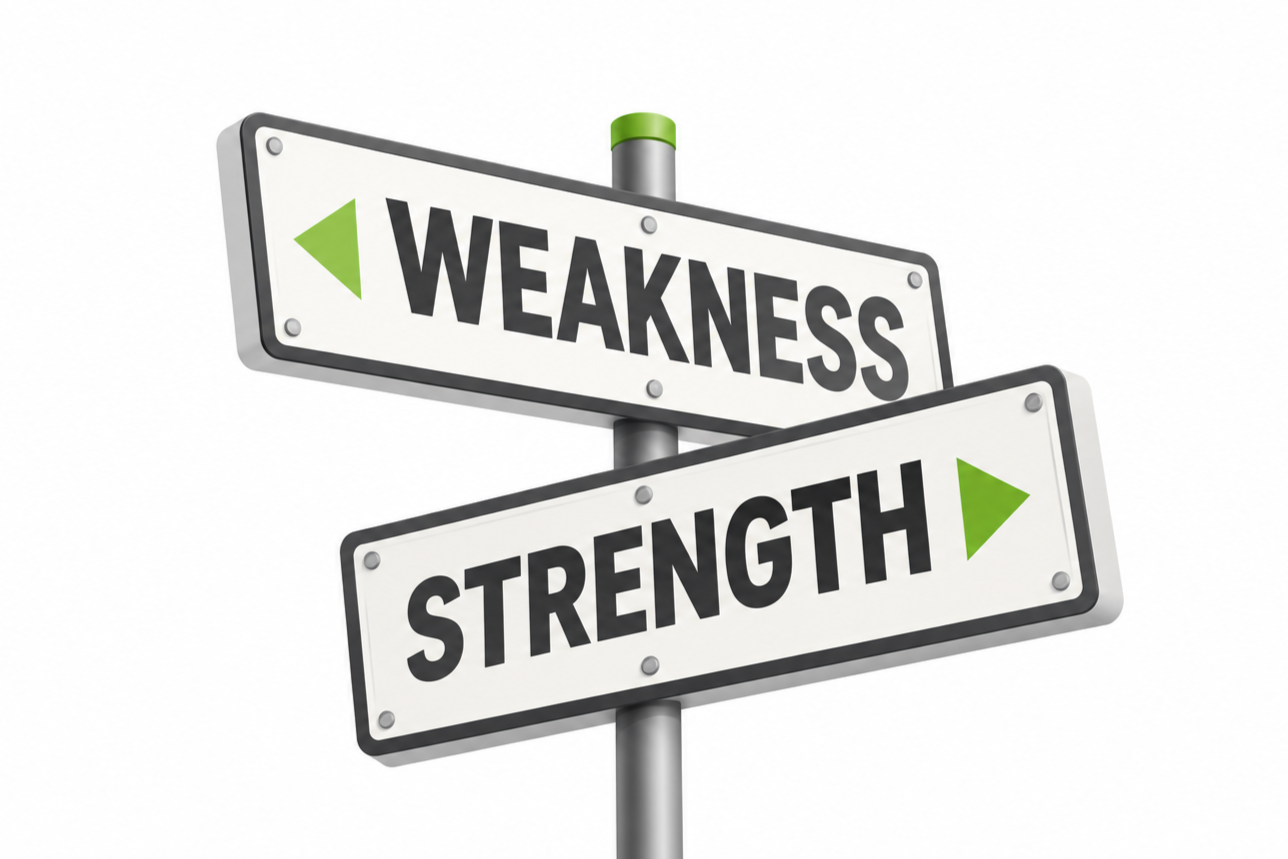
“Focus on your strengths,” many people say. It’s a fantastically positive and life-affirming piece of advice, but is it right?
With nearly three quarters of businesses allegedly moving towards a strengths-based model, we really need to know.
If the advice is wrong and we follow it ourselves, we risk hobbling ourselves and our careers by ignorantly indulging in some Pollyanna fantasy. If we’re leading others, though, the potential downside is even greater: we run the risk of patronising our people, wrapping them in leadership cotton wool and limiting their ability to deliver for us, our organisations and themselves. We risk encouraging mediocrity, self-indulgence and an overblown sense of entitlement.
So, what’s the evidence for and against?
The argument for focusing on your strengths
It increases engagement: Marcus Buckingham’s seminal book Now Discover Your Strengths and the popular Strengthsfinder tool are based on a significant amount of research. They sell us messages that are consistent with the growing discipline of Positive Psychology and one study’s findings that people who have the opportunity to focus on their strengths every day are six times as likely to say they’re engaged with their work and three times as likely to report an “excellent quality of life” [2]. This makes a strengths-focus an important antidote to traditional “deficit based” approaches. We’re so used to the feedback sandwich now that few of us even listen to the good news because we’re primed to wait for the bad. Far too few of the hundreds of leaders we’ve worked with invest as much energy in understanding the positive feedback they receive as they do in understanding “constructive” comments on their performance.
Basic psychology has long held that positive reinforcement is the best food for learning: These positive messages are also consistent with psychological findings that positive reinforcement (praise) is more effective as a tool for shaping behaviours than is criticism. Similarly, this call to embrace the positives chimes with findings that the ratio of positive to negative feedback that is most likely to create a ‘high performing team’ is 3:1 – three pieces of encouragement for every piece of what HR people like to call ‘constructive feedback’(more about that ratio later). This ratio is in stark contrast to the 1:16 ratio we reportedly experience as children – yes, that’s 16 negative or correcting pieces of feedback for every positive, affirming one [3]. Thus it’s no surprise that the anxious over- (and under-) achievers among us jump at the chance to be encouraged to focus on what we’re good at and ditch everything else.
Our bosses will probably think better of us if (they think) we’re leveraging our strengths: the aforementioned research on feedback fits a thread of research suggesting learners do better over the course of an academic year when their teachers think they're working on something they're naturally good at - even if the learners are randomly assigned and have no natural talent at all [4]. So, if your boss thinks you're focusing on your strengths you may be more likely to improve your performance even if you are in fact focusing on tackling your weaknesses - more on the “weakness” word later, as it's deeply unfashionable in Learning and Development circles.
It’s easier to practice something you’re already good at: In some respects, focusing on our strengths may appear to align with perceived wisdom [5] that it takes 10,000 hours to get really really good at something. After all, given that 10,000 hours is almost 60 weeks of unbroken attention and practice, most of us would be hard pressed to master more than a few things in the course of our careers: "chase five rabbits and you won't catch any of them," to tweak one of my favourite native American sayings. So it's probably best to choose something we've shown a natural aptitude for, right? Otherwise we're just pushing a boulder uphill. Probably best to pick something we also enjoy, too, right? We're far more likely to stick at it for those 10,000 hours.
Focusing on our strengths is what we’ve always been told to do when choosing our career paths: This is also often the approach taken to career transitions or outplacement, where by focusing on what the individual is good at and enjoys, they can identify and explore their optimal career options [6]. So we look for that sweet spot at the centre of three overlapping circles: the things we're best at, the things we enjoy most and the things that'll bring us the greatest pay-off - whether that's in financial terms, career progression, or something else.
If you were a business, you’d invest in what you’re good at, not what you’re bad at: You wouldn't put most of your investment into the products, services or departments that are failing, would you? You'd invest in your strengths - the most profitable areas of the business. Right?
The argument against
There are a number of reasons why it’s risky to overplay the focus on our strengths. In examining these, it’s important to recognise that the real experts in “strengths-based” development are far less zealous in ignoring weaknesses than the hype would have us believe – but we’ll come to that shortly.
People aren’t businesses, they’re people: It’s easy to draw that analogy between people and businesses, but is it flawed? What about the risks of investing in companies that are on an all-time high, for instance, or in markets at their peak? The nature of a peak means there’s only one way for our investment to go: down. Many wise investors invest in potential or make their money by buying up stocks when they’re down, then cashing in when those stocks increase in value. So what does this say about the advice to invest only in our strengths?
We need balance: all three of us are keen runners. As we’re all over 40, this means if we don’t pay due attention to technique we’re prone to the kind of injuries that’ll stop us running for weeks and months. ‘Technique’ means attending to far more than my feet and legs. It means paying attention to the whole system – the entire skeleton, the muscles and connective tissues that keep it running and the food and fluids that feed that system. Each of us has learned the hard way that if we focus on strengthening one part of that system it’ll cause problems elsewhere. If one leg gets stronger or more flexible than the other, for example, the runner will be out of balance – perhaps imperceptibly on a treadmill, but enough to damage their Achilles over a distance of 10km or more. It’s the same with skills and character traits: if an individual majors on their natural assertiveness and leaves their underdeveloped empathy to someone in HR, they’ll cause problems for themselves and others. Human behaviour is often described in binary terms: you are either strategic or operational; extraverted or introverted; confident or self-doubting. In reality, most effective leaders move back and forth on a continuum from one situation to another. They recognise what Kaplan and Kaiser [7] call the Yin and Yang responsibilities of leaders: the need to couple one extreme with its opposite rather than sticking with one to the exclusion of the other – leaders, after all, need to have the longer term vision and bigger picture in mind, while also identifying concrete, short-term actions and attending to the details.
Overused strengths are liabilities: All strengths have their dark sides: we’re big fans of Hogan’s ‘dark side’ measure, with its eleven traits rooted in psychiatric disorders. Whether you like it or not, there’s no escaping that every strength, when overused, becomes a weakness – to the extent that it can derail a person’s career. This can particularly be an issue for senior leaders who often receive little or no open and honest feedback from the people below them in the hierarchy.
Unchecked weaknesses can be liabilities, too: Hogan’s derailing strengths aside, extensive research by the US’s Center for Creative Leadership shows five key weaknesses that typically hamper a leader’s route to the top of their organisation. Focusing on one’s strengths leaves these weaknesses unchecked. It’s like entering a round-the-world yacht race confident that you’ll win because you have the best sail in the competition and that it’ll more than compensate for the hole in the bottom of the boat. Organisations do all four parts of a SWOT for a reason; they don’t stop at S or focus only on S and O.
Different tasks, roles and environments require different strengths: species that focusing on doing one thing really well generally die out when their ecosystem changes. They’re simply not resilient. Marshall Goldsmith’s “What got you here won’t get you there” attracted almost as much excitement when first unveiled as did Marcus Buckingham’s call to focus on our strengths, but the need for resilience goes beyond adapting to the needs of more senior roles. Different team members, organisations and economic cycles demand different leadership styles.
Some paths offer higher risks and/or lower rewards than others: let’s face it, if your greatest strength is playing tennis and you’re better at it than 99.9% of people, you’re still one of 7 million people hoping to make it to the final at Wimbledon.
The language of strengths can be embarrassingly inaccurate: it may sound politically correct to say that the lowest rated of 67 possible strengths is your “most under-used strength”, but let’s be honest here. If there are 67 possible strengths and your “strengths profile” places each of them in order, with your greatest strength at the top, the one at the bottom is by no means a strength for you. It is, relatively speaking at least, a weakness.
Similarly, as popular as it has proven to be and as much as it chimes with many Western 21st Century ideologies, that golden ratio of 3 positives to every negative may be pure fallacy. An analysis of the three studies on which that ratio was based concluded that the ratio is "completely vitiated by fundamental conceptual and mathematical errors, and above all by the total absence of any justification for the applicability of [the ratio to human performance and development]"[8]. The authors also point out the lunacy of thinking a simple ratio applies across all ages, socioeconomic groups, genders, cultures and types and sizes of team. After all, nothing else in human psychology has proven so perfectly consistent and impervious to the pull of diversity.
Focusing solely on strengths can block learning: some of the well-known models of adult learning (such as Kolb’s Learning Cycle and Double Loop Learning) highlight the need to reflect on, identify and challenge our underlying assumptions and conclusions. This enables us to modify existing behaviours and experiment with new ones, but we can only do so if we challenge our prevailing mind-sets as it’s those that maintain our habitual ways of behaving and responding to the world. If we’re primed to focus only on our strengths, we’ll see those habitual behaviours as either strengths to dial up or weaknesses to ignore, which’ll prevent us from questioning our underlying thinking.
In conclusion
There is plenty of evidence to support the merits of leveraging strengths for development. At the same time, we need to avoid getting carried away. The most robust “strengths-based” approaches avoid ignoring weaknesses. Rather they “dial up” the attention paid to strengths as a response to a history of focusing fairly exclusively on what’s “wrong” with people [9]. They recognise that we also need to work on areas that are not our natural strengths, particularly when these are likely to undermine or derail our success.
The reality, then, where this “strengths-based” approach is concerned, is that they key lies in achieving a healthy balance. We need to be aware of and understand our strengths, recognising our potential to overuse them and the fact that they may have been the foundation of our success to date but could become inhibitors – even blockers – when it comes to our future success. We need to know when to dial them down and when to dial up other behaviours that we might not favour or could even consider “weaknesses”. As Scott Blanchard, executive VP at the Ken Blanchard Company, recalls “modulation became the key to help me achieve my goals” [10]. Or, as one executive put it “I don’t have to give up my fast ball. I just don’t have to throw it all of the time.” [7]
Where development is concerned, the evidence suggests we need to make wise, focused investments of time and effort. Most work, and most leadership, is a team sport: precious few of us can be perfect at everything. As fellow psychologists David Pendleton and Jon Cowell point out, we all have some “resistant limitations” that could require an enormous amount of effort to crack. Pendleton and Cowell suggest we delegate related activities to others. Sage advice, to a point: like it or not, it’s individuals that get rewarded, promoted, punished and fired in organisations. You can delegate your weaknesses to someone else in the team, but – unless you’re working for a highly progressive organisation – when it comes to assessing who’s delivered greatest value, it’s the package you personally offer that will be the deciding factor. So choose carefully where to invest your development efforts.
Finally, it’s important to recognise that some "development needs" aren't development needs at all: they're just weaknesses. Sure, it’s far more acceptable to use “development needs” as a polite catch-all for anything people aren’t good at. But let’s be grown-ups here. Richard is pretty dreadful at tenpin bowling. It's embarrassing: his daughter thrashed him at 8 years old and his wife slaughtered him with her off-hand. This isn’t a development need, though. It’s a weakness that has very little bearing on anything remotely important in his life or career. In fact, you could say that weakness is a source of strength - not because it stirs some great quest for betterment, but because of the pleasure it gives his wife and daughter!
Richard, Rebecca and Bernard are psychologists and coaches, developing leaders and leadership teams by helping them leverage their strengths, manage the dark side of those strengths and tackle the "weaknesses" that matter. Find out more about them on our ABOUT page
References
1. From research presented at Zircon’s Talent Gene accreditation training.
2. From research presented at Zircon’s Talent Gene accreditation training.
3: Study cited in J. Canfield and M.V. Hansen (1998) Chicken Soup for the Soul.London: Vermilion.
4: Research by US National Parent Teacher Organization
5. See, for instance, M. Syed (2011). Bounce: The myth of talent and the power of practice. London: Fourth Estate.
6. E. Trenier (2010). Using strengths to guide career transition. Assessment & Development Matters, Vol.2(2), pp 5-7.
7. R.E. Kaplan and R.B. Kaiser (2013). Fear Your Strengths: What You Are Best at Could Be Your Biggest Problem. Berrett-Koehler Publishers, Inc: San Francisco
8. N. J. L. Brown, A. D. Sokal and H. L. Friedman (2013) The Complex Dynamics of Wishful Thinking: The Critical Positivity Ratio. American Psychologist, Vol. 68(9), pp 801-813.
9. D. Mackie (2016) Strength-Based Leadership Coaching in Organizations. Kogan-Page.
10. M. Blanchard (2011). Strengths: The Double-Edged Sword. Chief Learning Officer. Vol. 10(10), pp 32-34.