With so much other leadership wisdom out there, why should we pay attention to the ARC Leadership book?
It’s easy to say leaders should be Authentic, Responsible and Courageous, but what’s the evidence that these three qualities will deliver genuine value to leaders and their organisations? And why these three over all the other admirable qualities we might look for in a leader? Richard answers these critical questions, offering further insights into the reasons for his first book.
It’s easy to say leaders should be Authentic, Responsible and Courageous, but what’s the evidence that these three qualities will deliver genuine value to leaders and their organisations? And why these three over all the other admirable qualities we might look for in a leader?
There are countless qualities we might use to describe an ‘ideal’ leader: wise, determined, focused, fair, intelligent, creative, inspiring, charismatic, transformational… The list goes on. So why have you chosen to focus on these particular three?
Some qualities are red herrings. You need a certain amount of intelligence, for example, but the research shows it’s not a great predictor of success as a leader – and too much intelligence can get in the way of leading effectively. Other qualities do show up consistently and convincingly in the research but are requirements or natural by-products of being simultaneously Authentic, Responsible and Courageous. Leaders who are true to themselves, bold in their vision and approach, and encourage their people to take due responsibility for something bigger than themselves will be inspiring. Being focused and determined means being Courageous in deciding what not to do, too – to make difficult sacrifices and have the necessary difficult conversations with staff and other stakeholders. I’ve also found that the qualities we want in those who actually lead us are quite different to the qualities we see in the great, ‘ideal’ leaders whose leadership we experience only from afar – the famous generals, politicians, innovators and revolutionaries we’ve been taught to adore. By putting these people on pedestals, we risk discouraging those everyday leaders who’ve no aspirations to change the fate of nations or have their names recorded in the history books. ARC offers all of us something that is both aspirational and realistic: they’re qualities we all have and can all improve upon.
“This book had a real impact on me. I absolutely believe these three ARC qualities are necessary to become a better leader. Business schools in particular would do well to pay attention: given what’s gone on in corporations over the years, they need to take greater responsibility for producing business leaders who aren’t simply be able to profitably grow a business, but are - to their core - Authentic, Responsible and Courageous”
In your book, you argue that these three words – Authentic, Responsible and Courageous – offer so much more in combination than any one of them does in isolation. Can you tell us more?
You’re right, and that’s one of the reasons I’ve chosen to focus on these three qualities in particular. They’re great in isolation. That’s why we have a whole literature on Authentic Leadership, a growing movement trying to get leaders and their organisations to be more Responsible and a few good books, articles and TED talks aimed at helping us be more Courageous. What’s often overlooked, though, is the interaction between these three qualities. Sometimes they help each other, but all too often they get in each other’s way. Plenty of people in the banks and hospitals who’ve made the news for the wrong reasons want to do the Responsible thing, for instance. The problem is that they lack the courage to stand up to peers and seniors who are acting irresponsibly. For some of some them, that lack of courage will be rooted in the tension between their responsibilities to customers or patients and their responsibilities to their families. They’re afraid that if they stand up to malpractice, they’ll lose their jobs and that’ll affect their ability to provide for people who are relying on them.
So how do these three qualities help each other?
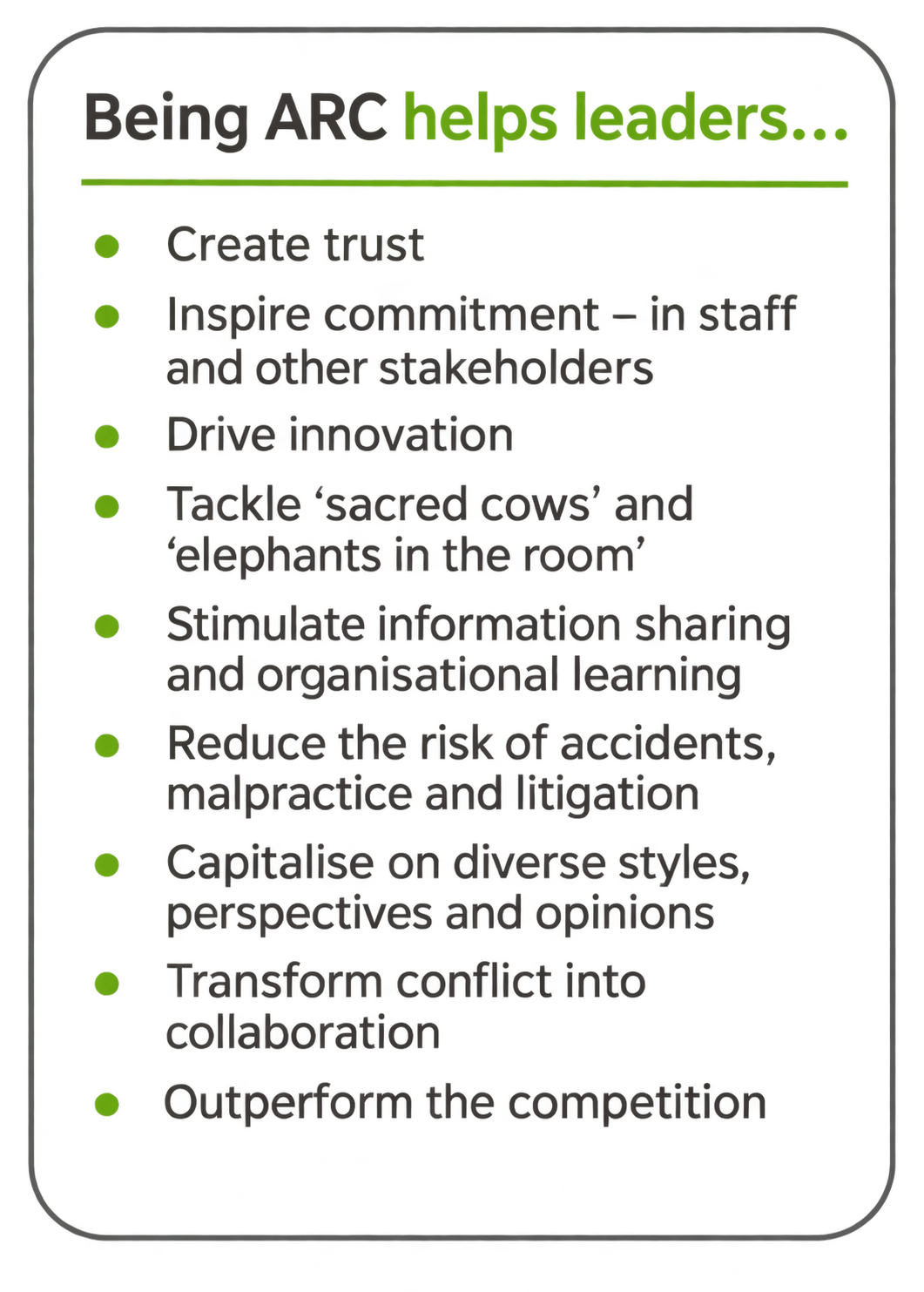
In two ways. Firstly, in the way they combine to address key challenges we face as leaders in organisations. It takes authenticity, responsibility and courage to create and maintain trust, for example – something that’s in increasingly short supply in the private, public and ‘third’ sectors. Being ARC also helps us inspire commitment in an increasingly diverse and transient workforce, in spite of ambiguity and continual change – not just from our staff, but from other key stakeholders. It helps us attend to our competence and that of others, and harness diverse styles, perspectives and opinions. Teams and organisations that are Authentic, Responsible and Courageous are also more likely to share knowledge in ways that are productive and efficient, and will continually adapt their ways of thinking and working. All of these things act in service of the one thing all leaders are paid to deliver: results. The research suggests leading authentically instils high performance behaviours in team members and reduces accidents and formal grievances. Responsible leadership encourages staff to take responsibility themselves and there’s evidence that, in the long run, Responsible organisations outperform their less Responsible competitors.
These are benefits for the organisation, though. What’s in it for the leader themselves?
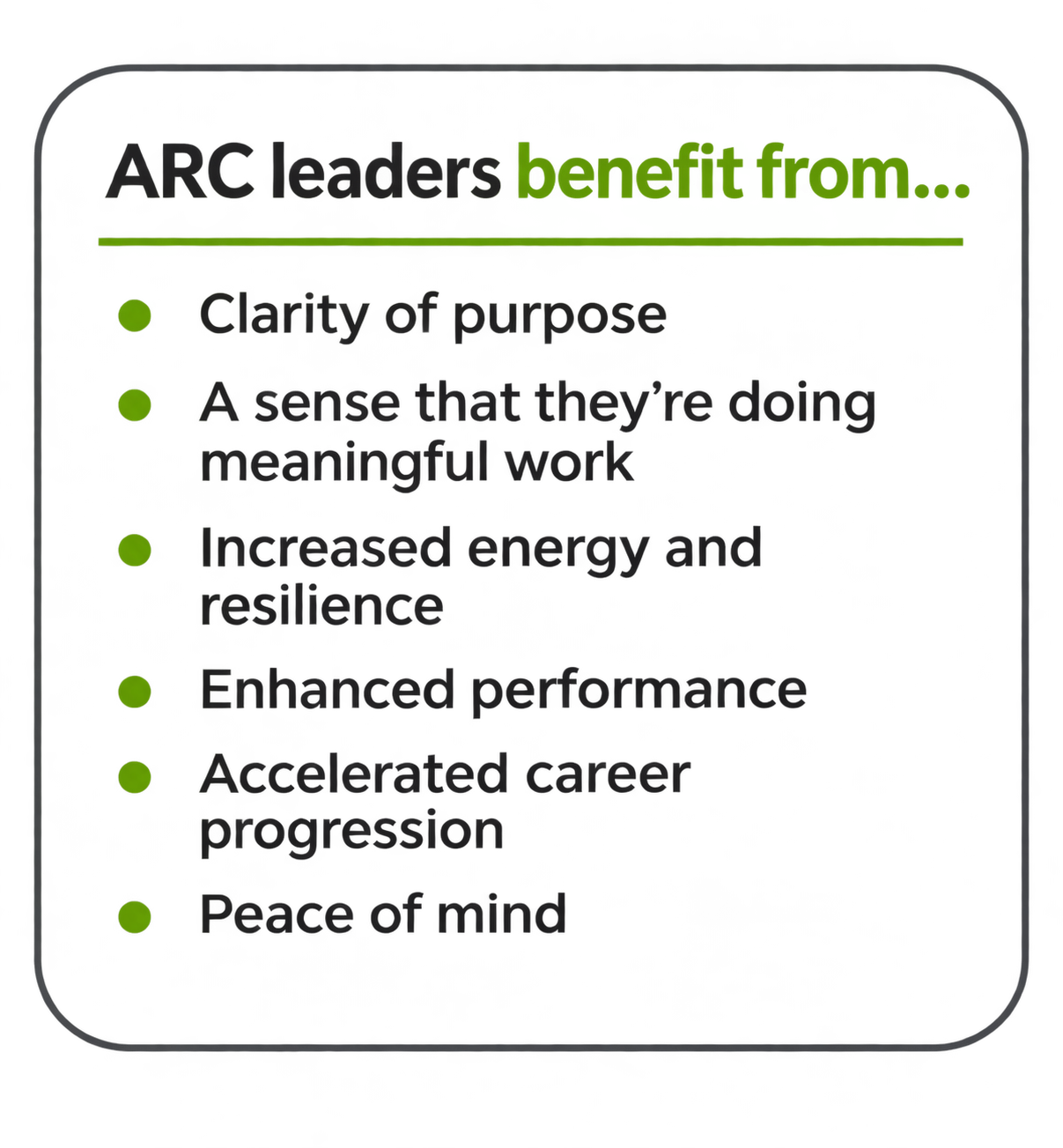
You’re right. It’s not easy being ARC and most of us are selfish to some extent. ARC is both rewarding and sustaining for those who choose to pursue it. Rewarding for three reasons. Firstly, by attending to what’s really important to us and what’ll really make a difference, it gives us a real sense of purpose – critical in a leadership position, particularly a challenging one. Secondly, these three qualities drive individual performance. Thirdly, they also help us progress in our careers.
That sounds rewarding. You also said ARC is sustaining.
Yes. The sense of purpose it brings helps us be more resilient. If I don’t have a really clear sense of direction that I’m really committed to, it’s hard to keep going when things get difficult. ARC also builds confidence and connects us to other people, both of which are a source of energy – being in Authentic literally drains our energy.
ARC also gives us the moral high ground, which shields us in difficulty, and helps be more robust in defending our own position – robust, but not dogmatic or defensive. We’re also more likely to stay on the right side of our administrative, legal and moral commitments, which keeps us out of trouble. And we’ll help maintain the physical, social and socio-economic ecosystems on which our individual success and survival depend.
You said there was a second way in which these three qualities help each other…
I did. Used well, each of the ARC qualities feeds the others. When we’re struggling to find the courage to take a stand, for example, we can draw on authenticity – by asking what our values say we should do – and our sense of responsibility to something bigger than ourselves. It’s this that helps us overcome the fear of saying ‘No’ to a superior or client who’s demanding something we believe is wrong or unfair, for example: we test their request against our values and ask what our responsibilities really are – to the organisation and its reputation, to our profession, to the colleagues who rely on us and the staff and colleagues whose future conduct we influence.
“This book is absorbing as reading a novel and demonstrates what ARC means through practical exercises that encourage self-awareness and reflection. I am working hard to incorporate Authentic, Responsible and Courageous leadership into my daily life as a member of the senior team at The British Library. Doing so is helping develop the trust of my colleagues and stakeholders and ultimately to improve my performance”
You also refer to leaders using the three ARC qualities to make decisions and resolve dilemmas.
That’s been one of the exciting accidents of my research. It turns out most leadership challenges can be described in terms of a difficulty with one or more of the three ARC qualities – or the tensions within and between them. Once we’ve worked out which quality lies at the heart of our dilemma, we can look for solutions in the other two qualities – or in some of the tools and techniques I offer in the book, which are aimed at helping us be more Authentic, Responsible and Courageous. There are some examples in the book. One of my favourites tells of Nicola Masters, the head of a British charity. In exploring her challenges using the ARC framework, she and her executive coach realised she and her team were being very Authentic but were favouring being Responsible over being Courageous. This triggered a shift in Nicola and across the charity, leading to a bolder way of working that raised its profile and dramatically increased its income.
“Since my executive coach introduced me to the three ARC qualities, they’ve become my ‘mighty three’. The words Authentic, Responsible and Courageous are on the wall in my office and together they inform every major decision we make at The Grand Appeal”
So the book’s aimed at executive coaches, too?
It’s primarily a book for leaders – people at any level, in any kind of organisation, who are leading others. But it’s full of important questions and techniques – as well as insights into the things that make it hard to be as Authentic, Responsible and Courageous as we might like to be. So there’s plenty of material there for coaches and other Learning and Development professionals. I’ve run workshops especially for coaches, helping them use the material and I’m considering developing another book just for them. But I’m also keen to produce another book focusing on team performance, rather than individual leaders, so – if there’s sufficient demand for a book for coaches – I’ll probably produce it in collaboration with some of my favourite coaches.
So, this is bigger than this one book, then?
The more I explore and share these three ARC qualities, the more applicable I find them. One coach I know is using them to help women recover from trauma and I believe they’d be enormously helpful in schools and youth groups. Even though I’m a psychologist by training, these aren’t my areas of expertise, so I’ve an interest but I’ll leave the details to people with the relevant specialisms. I’ll stick to my chosen disciplines of leadership and team performance, because I’m more convinced than ever that – if more leaders and teams can manifest these three qualities – they’ll benefit, their organisations will benefit, their clients, customers, shareholders and service users will benefit, and so will the rest of us.
“An excellent book and an inspirational template for a better way of leading and living. It is positive, hopeful, intelligent, friendly, shrewd, eye-opening, evidence-based and incredibly generous. It’s a book that challenges us and supports us like a great coach or trainer would do, provoking great insights and creating a renewed, fresh sense of purpose - part character review, part campaign for personal overhaul. This would be a wonderful centrepiece to a leadership development programme, and what an awesome course that could be. Indeed, I believe that this book will become a standard text”
“One of the most thought-provoking books I’ve ever read. It touched numerous nerves with me and shone a light beautifully on my own leadership, my years at the BBC, ITV and Disney and the way we lead at Nickelodeon. It’s a book shareholders will be waving at CEOs, expecting Authentic, Responsible and Courageous leadership as key to providing competitive edge. A must read for any ambitious CEO and for management teams - whether their focus is the bottom line, thriving in the face of 21st century challenges, or leaving their own personal legacy in the organisation”