Top team / Flop team - our thinking takes centre stage
At a recent gig, rap-rockers Hollywood Undead created a high-profile, high-stakes team composed of absolute strangers who were together on stage for a matter of minutes. In doing so, they demonstrated the power and inescapability of the Three Core Disciplines for Leadership and Team Performance.
At a recent gig, rap-rockers Hollywood Undead created a high-profile, high-stakes team composed of absolute strangers who were together on stage for a matter of minutes. In doing so, they demonstrated the power and inescapability of the Three Core Disciplines for Leadership and Team Performance.
Those of you who know me well, or have read a few of my articles, will know I’ve an eclectic taste in music that includes the more… raucous end of the spectrum. I’ve written previously on the importance of the three ARC Leadership qualities – authenticity, responsibility and courage – in the “mosh pit”. I go to other gigs, too, but the softer-sounding ones rarely inspire me to reflect on group psychology.
So, the other night, when a client-turned-friend took me to see Los Angeles based rap-rockers Hollywood Undead, the band’s antics got me thinking again. Part way through, they invited four members of the audience on stage – not to stage dive or simply hang around, but to play their instruments. It was a bold move on a number of fronts, and it demonstrated the applicability and inescapability of our Three Core Disciplines in yet another context.
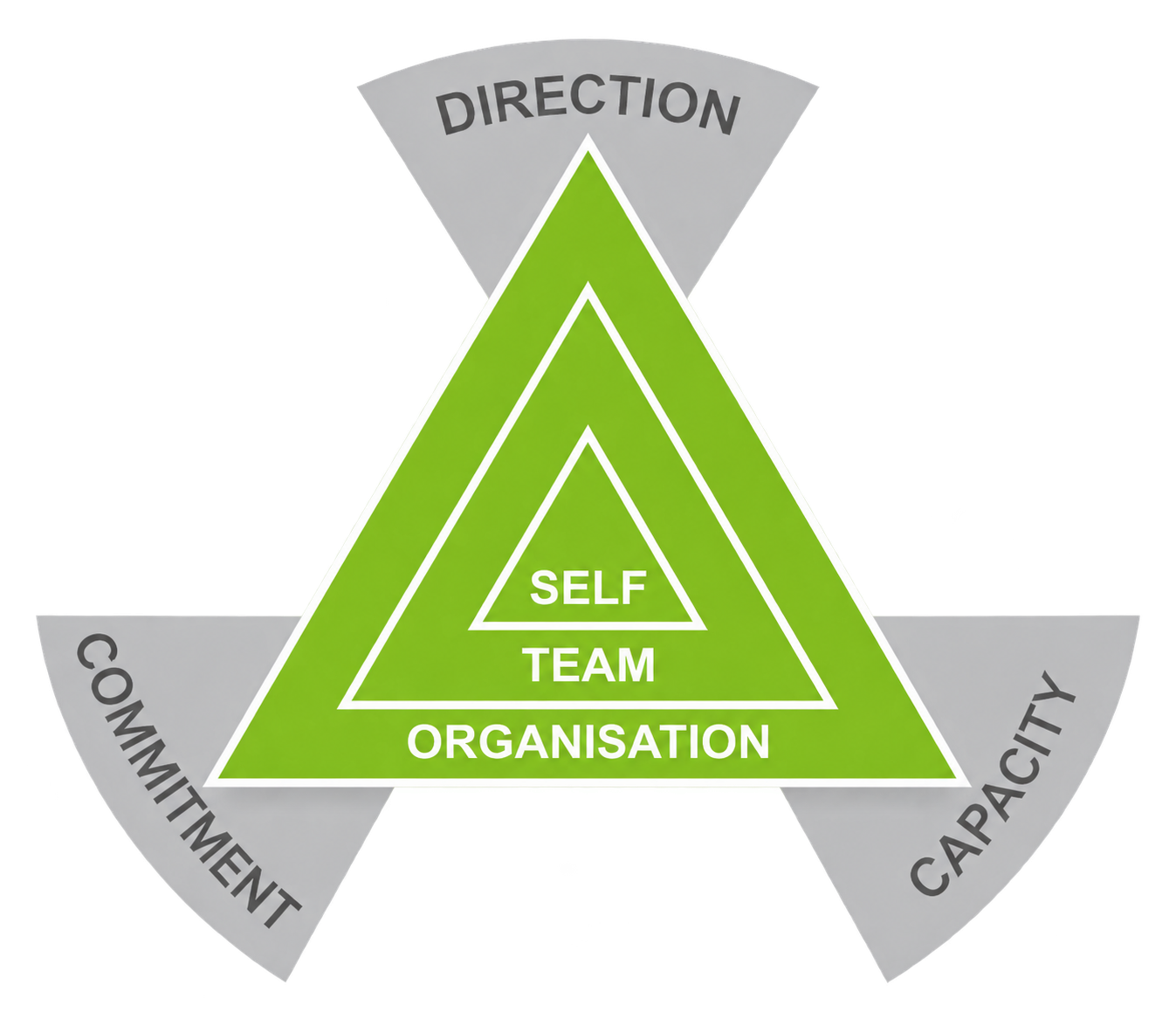
The Core Disciplines tell us that, to be “high performing” and deliver real value for its members and their stakeholders, a team needs:
A clear direction that is aligned with direction its members, stakeholders and surrounding organisation want to head in
The full commitment of its members, stakeholders and surrounding organisation
Sufficient enabling capacity within and around the team, and a focus on continually building its capacity so it evolves at least as quickly as its external environment
Let’s start with capacity. From a professional perspective, the selection process for this impromptu team was pretty appalling: front man Jordan “Charlie Scene” Terrel simply asked “Who can play guitar?” then chose whoever looked sufficiently confident and dragged them up on stage, then moved onto the next vacancy. On one hand Terrel was in a hurry as he had an audience to entertain; on the other, far too many organisations, leaders and HR practitioners favour ease and speed over accuracy when building teams or filling empty roles – they, too, are under time pressure and the scrutiny of demanding stakeholders. The result? Leaving the team’s capacity far too much to chance.
The importance of ensuring the team has sufficient capacity – rather than trusting it to chance – quickly showed. Once on stage, the four members were asked to demonstrate their skills. The guitarist failed pretty miserably, delivering a slow, high pitched sequence of notes that suggested this could have been the first time he’d ever touched a guitar. Terrel could have taken action at this point and ditched the guitarist. He could have replaced him with someone else from the audience, risking delaying the launch and frustrating his sweaty stakeholders. He could have called on one of his Hollywood Undead colleagues, contracting in external expertise as many teams do, undermining the purpose of creating the team in the first place but ensuring the team delivered. Or he could have launched the project with one role unfilled. He chose to push on with what he had, hoping the rest of the team would pick up the guitarist’s slack.
Fortunately, the drummer and bassist both delivered. The bassist was particularly impressive. The crowd was clearly surprised: while this 20-year-old man didn’t look like your archetypal rock god. It was something of a Susan Boyle moment, proving that rap-metal-fusion fans are just as prone to nonsensical stereotyping as most people. As always, when we’re selecting team members, we need to look beyond the surface and to draw on a diverse pool of talent (although it’s notable there were no women in this team, despite the number of women in the audience). As always, the best way to guarantee your team members have the necessary talent is to ask them to demonstrate it before you take them on, rather than relying on first impressions, a convincing interview patter or an impressive CV.
As if to confirm this point, Hollywood Undead front man Terrel finally turned to the guest vocalist, commended him on looking the part and told him to “Sing something.” These two, simple words instantly turned a bouncy, fist-pumping young man into a floundering guppy fish. Time stood still as the audience waited for him to impress them and the wannabe vocalist struggled to think of something to sing.
The missing piece here was direction. The combination of high pressure and a lack of clarity over what he should do got the better of him. It’s a common issue in organisations: a combination the UK's Health and Safety Executive has linked to disengagement, staff absence, burnout and long-term stress leave. The young man’s stress was palpable. Fortunately, his stakeholders came to the rescue. They started singing one of Hollywood Undead’s signature songs, driven by their own commitment to having a good time and their desire to rescue a fellow fan from humiliation. All the guest vocalist had to do was listen to his stakeholders, align with the direction they wanted to go in and fully commit to it. As soon as he did, he found his (impressive) voice and within seconds he was leading the crowd not the other way round. Almost immediately, the bassist and drummer were playing along, their zealous commitment buoying the team and entertaining us all.
The team’s commitment came from a blend of factors we can draw on when motivating our own teams, high performing or otherwise:
Having a clear direction they could sign up to heart and soul
A shared endeavour that motivated each team member at an individual level
A sense of shared identity founded on clear common ground (initially their taste in music, then a clear boundary between them and the rest of the world and a shared sense of the pressure placed upon them)
Knowing their stakeholders were also fully committed
Stakeholders’ clear and immediate feedback on their performance
Increasing trust in each other’s capacity to deliver
Okay, so the caveat on the capacity front is the lack of a talented guitarist. Fortunately, the guitarist did demonstrate some (late) self-awareness and opted to jump up and down with his hands in the air, enjoying the moment. Where the Core Disciplines are concerned, he was no longer committed to the shared endeavour. We could hypothesise two reasons for this: his lack of capacity to fulfil his role and his earlier decision to pursue personal gain (5 minutes of “fame”) rather than the greater good (leaving the opportunity for someone better equipped to deliver for the team and their audience). You could argue that he adapted to the situation, offering as much contribution as he could. That’s very generous and compassionate of you, but he really didn’t add any value. He merely took himself out of the equation to avoid having a negative impact on the team’s performance. But he left a gap, one that one of Hollywood Undead’s own guitarists soon filled – showing the impact on a team’s performance of having a supportive external environment.
Why do I favour the wannabe singer over the wannabe guitarist? Perhaps it’s empathy: in the '90s, I was the lead singer in a band with lots of commitment but middling talent (i.e. capacity) and a chosen musical direction that was too “niche” to secure the commitment of a large audience. So maybe I feel more sympathy for the singer’s plight, but I like to think I can be reasonably objective here. Where that guest guitarist and guest singer at Hollywood Undead are concerned, there’s a difference between:
Succumbing to stage fright causing you to draw a blank, fail to take action and seek guidance; and
Choosing your own direction and taking action in spite of a lack of sufficient skill, and consequently making a mess of things
With clear direction and support from fans and fellow team members, the vocalist delivered. The guitarist didn’t.
But he had fun, and so did the rest of us, and within ten minutes the team was disbanded. The real band retook the reins and continued with the rest of the show. As I threw myself back into the music, I couldn’t help but notice how tight they themselves appeared as a team. They modelled all three Core Disciplines. Their capacity as vocalists and musicians was obvious, as was the capacity of their supporting crew to keep the show moving slickly despite numerous changes of instruments. They delivered with full commitment throughout and they clearly had the devoted commitment of their singing/shouting, sweating customers. And their direction was clear at a team level and an individual level: their roles changed constantly, each band member switching instruments repeatedly between songs, but everyone in the team remained 100% clear on their own evolving role and the evolving roles of their team mates. Are they a good band? Well, perhaps that depends on your music taste. Are they a high performing team? Most certainly.
Richard Boston and his colleagues at LeaderSpace specialise in developing high-performing teams for organisations as diverse as Deloitte, Heineken, a multinational mining company, the Department of Health and Southampton Football Club. He’s a popular guest on the USA’s Team Coaching Zone podcasts and webinars and works with some of the world’s leading business schools.
For more information about the LeaderSpace team and case studies, visit our ABOUT page. To read numerous articles and podcasts written by Richard and the team, visit our INSIGHT page. Please CONTACT us to explore how we can help you and your team be the best you can be.