Our thoughts in response to an article citing Deloitte’s research with tech leaders worldwide
Deloitte’s research suggested there are three ways of operating as a CIO. We reckon Deloitte is bang on, but ask:
a) whether this is just another tech fad
b) if it’s not a fad, how does it help us select and develop the 'right' CIO?
c) What does the latest leadership thinking tell us is missing from Deloitte's analysis?
An article in Computer Weekly cites Deloitte's latest research with over a thousand tech leaders worldwide. The firm's surveys and interviews suggested there are three ways of operating as a CIO: trusted operators, change instigators and business co-creators. Rather than ring-fence the three as separate 'types' - which is how the magazine appears to position the research - Deloitte suggests each CIO tends to major on one of these three ways of operating but that the best ones consciously choose the right 'mode' for the situation at hand.
I reckon Deloitte partner Mark Lillie and his colleagues are bang on there, and it's not just because I know Mark and (expression of interest ahoy!) my colleagues and I have been working with Deloitte since 2008. The reality is, straightforward typologies are far too frequently used to over-simplify reality and pigeon-hole people. We've a duty to ask three critical questions, though, and I intend to answer them:
Is Deloitte's latest research just another tech fad?
If it's not a fad, how does it help us select and develop the 'right' CIO?
What does the latest leadership thinking tell us is missing from Deloitte's analysis?
Is this just another tech fad?
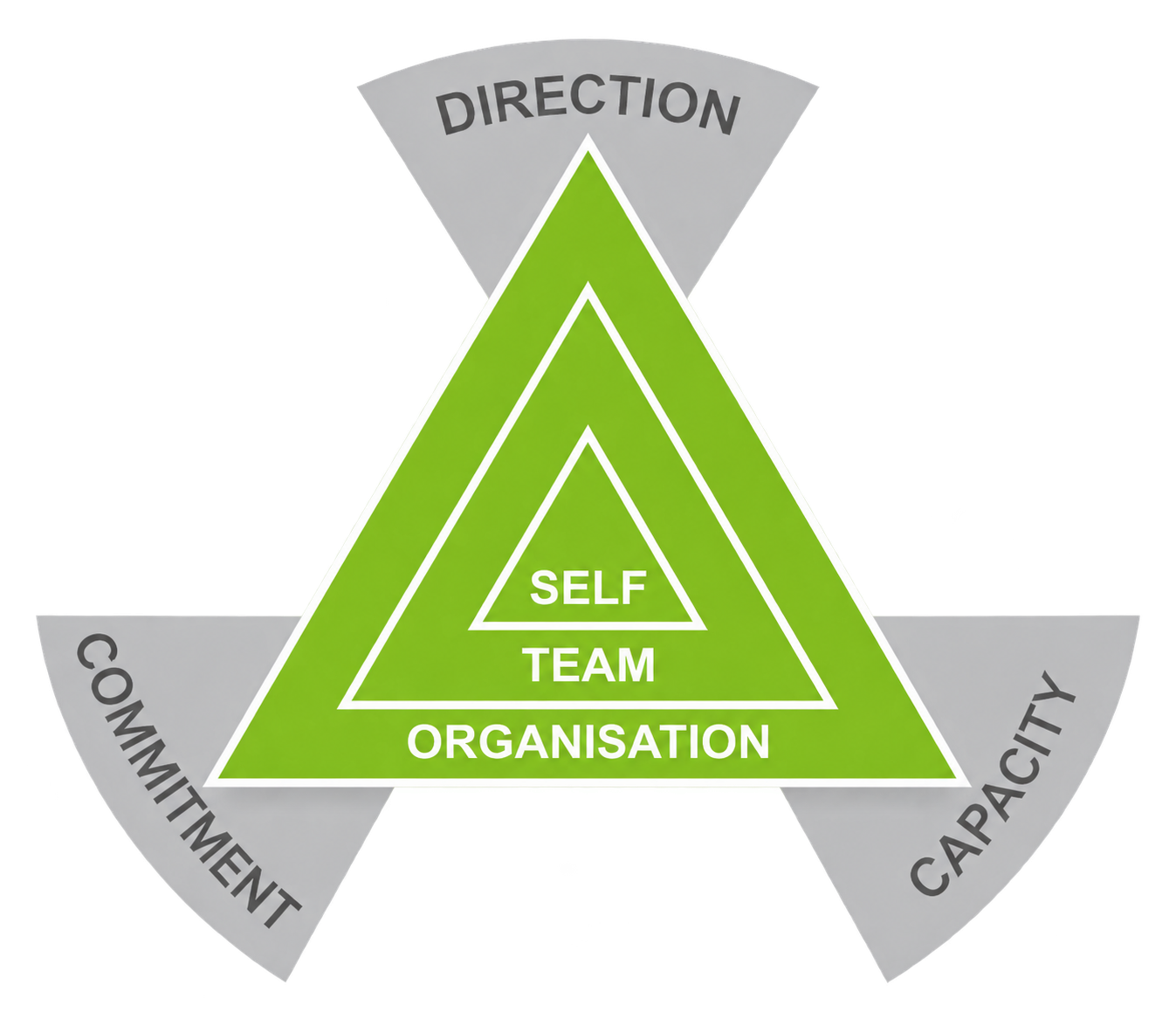
Not likely. These three ways of operating as a CIO map pretty well onto current leadership thinking. At LeaderSpace, my team and I summarise much of this existing wisdom under Three Core Disciplines of Leadership and Team Performance.
As you can see, each of these disciplines applies at the individual, team and organisational level. Each also has an internal and external component. For instance, a high-performing team will opt for a direction that meets the needs of its individual members and the organisation as a whole. That same team's success relies on its internal capacity and the capacity around it within the organisation. Similarly, a high-performing organisation will look internally and externally at its market when deciding which direction it should head in; it will also ensure that it has commitment internally, from its staff and leadership, and externally from its customers, suppliers, regulators, etc.
The Three Core Disciplines offer a helpful lens for assessing these three CIO 'modes'. It's a lens that helps us transfer this learning to other roles (C-suite or otherwise). It helps CIOs learn to dance between the three modes as appropriate. It helps us assess the ability of a given CIO to do that dance.
Critically, though, this lens also helps us see what we might be missing if we limit ourselves to just these three modes.
The trusted operator CIO arguably focuses on operational priorities around building and/or maintaining the organisation's capacity - the focus being on IT infrastructure that helps the organisation deliver on its chosen direction. In this mode, the CIO is unlikely to create radical shifts in the organisation's capacity, although he or she may greatly improve the capacity of their own team / department. Neither are they likely to bring about a significant shift in the organisation's direction. This CIO and their department are generally told what direction they should head in so that they deliver what those at the top believe the organisation needs. Where securing commitment is concerned, the trusted operator CIO's focus is often on the relationship with their boss, their own IT team and the CEO (as they rarely report directly to the top dog).
In change instigator mode, the CIO makes much more effort to understand the organisation's overall intended direction. They also look externally to ensure the needs of the business’s customers are factored into the way IT is delivered internally - i.e. to establish the direction of their own team. The focus of this direction is to deliver radical changes to the company’s current capacity, although they're still focused more on the IT capacity than broader matters of capacity in the organisation. They also draw on external capacity to effect change - whether that's skills, knowledge or resources. Indeed, it's common for the 22% of CIOs operating as change instigators in Deloitte's research to be brought in from outside, with the intention of them leading a specific transformation programme. Given the transformational nature of their work, change instigating CIOs secure commitment far more broadly than those in trusted operator mode. This includes reaching out across departments but also beyond the organisation, in order to form partnerships to make change happen.
When working as a business co-creator, the CIO focuses primarily on the organisation's overall strategy, seeing themselves first and foremost as a business leader. Their priority is value on the top and bottom line. They're much more likely to be the initiator of business initiates and to be a key player in M&A discussions than are CIOs operating in the other two modes. So, in this mode, there's a big focus on shaping the long term direction of the whole organisation, then aligning capacity-building with this new direction.
Somewhat tellingly, though, the 35% of respondents who favoured a business co-creator style spent only 30% of their time acting in that mode. What were they doing the rest of the time? Dividing it equally between acting as a trusted operator and a change instigator. For me, this finding reinforces the idea that these are modes of CIO activity. It also suggests the business co-creator is the ideal choice of CIO, whom it seems is defined by an ability to adopt whichever of the three modes is most appropriate for the time and situation. Mark Lillie and his team see business co-creators as the future for the CIO role, although they make it clear that CIOs need to establish trust and credibility in order to earn a license to operate in that mode. How? By proving themselves as trusted operators (and arguably change instigators).
I see three potential counter-arguments to the notion of 'business co-creator is best':
There are organisations that are so desperately in need of the operational focus of the trusted operator that they need their CIO 100% focused on that mode of operating.
Similarly, some IT transformation programmes are so huge that they need someone willing to be a change instigator 100% of the time
Developing the business co-creator capabilities requires time spent in the other two modes. If you're going to work on succession for the CIO and provide a platform for aspiration for more junior leaders, you're going to need to nurture those people operating primarily in the other two modes.
How does this help us grow and pick the right CIO?
Whether you’re growing future CIOs or picking them from a selection of new recruits, the combination of Deloitte’s three modes and the Three Core Disciplines offers a robust approach to assessing their suitability for the job. Each individual CIO can be described in terms of...
Their preferred direction, i.e. the proportion of their time that they choose to spend in each of the three modes
The extent to which they've secured a license to operate in each of the modes – i.e. people’s commitment to the CIO’s chosen direction. As Mark Lillie and Co observe, CIOs need to establish trust and credibility if they want to earn the right to become business co-creators. I'd argue that the CIO who wants to be able to move back and forth between modes will also need to gain the C-suite's commitment to them taking that flexible approach. Many CEOs will say they want a CIO who can flex their style to suit the needs of a changing organisation and operating environment. However, most people prefer their direct reports to be nicely predictable, to fit in pigeon holes and to not be a threat to their authority. A weak CEO might perceive an adaptable business co-creator CIO as a threat.
Their ability to operate in each of the three modes. This is a capacity question with three components. Firstly, to what extent does a given CIO have the intellect, knowledge and skills required by each of the modes? Secondly, how well to they create sufficient capacity in their own team / department to enable them to deliver on each mode? Thirdly, does the CIO in question have the ability to spot which mode is most appropriate at any given time? Finally, do they have the capacity to flex between the three? This means being personally adaptable and having the necessary array of technical, commercial and interpersonal skill-sets. It also means ensuring their staff, resources, processes and departmental structures support them moving between the three modes - which includes having direct reports who can at the very least maintain the department's 'trusted operator' status while the CIO attends to one or both of the other two modes.
So, what's missing?
It's hard to argue that Deloitte is missing anything about the ways CIOs currently operate. Not only does the firm boast a bunch of very bright people who know an awful lot about the world of CIOs, but they spoke to more than 1000 experts in the course of their research. However, the Three Core Disciplines suggest ways in which CIOs could go beyond the foundations of Deloitte's three modes to deliver even greater value than they already do:
Establishing direction means taking courageous decisions that meet the needs of the organisation's major stakeholders. What constitutes courage and which stakeholders get considered is largely a matter of mind-set. Now, each of the three CIO modes can be mapped fairly easily onto certain frameworks describing different leadership mind-sets. Many of those frameworks - including Bill Torbert's and Richard Barrett's - sort those leadership mind-sets into a hierarchy. Very importantly, none of Deloitte's three modes of being a CIO maps to the leadership mind-sets at (or near) the top of any of those hierarchies. This suggests there's a lot scope for CIOs to stretch their thinking further. For instance, by:
Taking on a role that makes a difference beyond the organisation
Challenging the C-suite to unlearn outmoded assumptions about the role of their organisation
Navigating the needs of a wider range of stakeholders, within and outside of the organisation so they're managing the socio-economic ecosystem in which they operate, rather than naively assuming the organisation exists in relative (and impermeable) isolation.
The change instigator and business co-creator modes both involve doing some really good work securing commitment. Both reportedly establish a broad base of relationships within and outside of the organisation. Whether they're true partnerships based on mutual gain and shared 'skin in the game' it's hard to tell. Certainly, in my experience, true strategic partnerships between organisations are rare and leaders who've come up the technical track - be they engineers or IT specialists - don't lead the field when it comes to creating genuine alliances across departments or between organisations. So, I'd warrant that there's scope for improvement here. Additionally, though, CIOs could do a lot more to contribute to / drive commitment in the culture of their organisations. Rarely is the CIO hailed as a key player here and rarely are they the ones in the C-suite orchestrating the sweet blend of trust and productive conflict necessary to get true collective commitment to the top team's shared endeavour.
How could CIOs do even more to build capacity? By applying this discipline at each of four levels: self, team, organisation and the world outside their organisation. Firstly, by role-modelling building their own capacity, focusing on continuous improvement of their own skills, behaviours, mind-set, etc. Secondly, by being a catalyst for every other member of the C-suite to continuously raise their game. Thirdly, be providing insights into the patterns and capacity gaps that help and hinder the organisation - not just the IT stuff, but the positive and negative forces at play in all departments, be they processes, structural factors, or questions of resources, people or skills. And finally, CIOs can deliver further value by building capacity beyond the organisation. Some leaders do it by mentoring future generations (or even previous generations). Some do it by creating, uniting, empowering and enabling communities of SME suppliers. Others by contributing to the socio-economic growth of a geographic region. Others by revolutionising the market - be it the market in which they themselves technically specialise (IT in the CIO's case) or the market their organisation serves.
Agreed, these are big steps for anyone in the C-suite, including many CEOs. But surely the true test of a CIO's value is whether he or she is a real game changer and a genuine contender of the top job...?
In summary
Deloitte's three modes are a great way of looking at the CIO role as it currently stands. Adding the Three Core Disciplines helps take things further, offering a quick and easy way for CIOs to navigate the three modes. The combination of modes and Disciplines enables CIOs and other C-suite operators to assess and adapt the way they're leading in order to deliver maximum value in a changing and demanding environment. Critically, the Disciplines tell us we can expect even more from this role. They help us see a future for CIOs beyond these three modes, showing how even the accomplished 'business co-creators' can become even better business leaders.