
What does it REALLY look like to ‘level up’ your ability to deal with complex problems?
In this article, we explore how your approach to ‘reasoning’ will be evolving through four distinct levels. The level you’re at will have a dramatic effect on your ability to deal with complex problems. So, it’s pretty shocking that so little attention is paid to reasoning in approaches to leadership development.
When we get stuck, stressed, make mistakes or plateau in our careers, it’s often because the challenge we’re facing outstrip our current approach in one or both of these two areas:
Reasoning – where we seek out, sift and interpret data in the hope of making rational decisions
Relating – forming, adapting and evolving relationships with the people around us, and even with ourselves
In this article, I’m going to focus on reasoning – primarily how it evolves through four distinct levels as we get better and better at doing it. Why reasoning and not relating? Well, if you’ve ever had an executive coach or attended a leadership or management development programme, the chances are the work focused primarily on relating. Enhancing your emotional intelligence, exploring your values, etc. Those kinds of things are almost always exclusively about relating to other people and different aspects of yourself.
Very little attention is given to the development of effective reasoning, particularly when it comes to complex problems. Someone might measure your current approach or capacity, using psychometrics, puzzles or business simulations. Other people might feed you some information that increases the amount of knowledge you have to reason with. But few people will be creating a significant shift in how you do that reasoning. Few people will be helping you get better at complex reasoning.
How reasoning evolves
Largely speaking, we have two different paradigms when it comes to making sense of the world:
‘Conventional’ thinking. This is the paradigm that gave birth to Newtonian physics, which is still a massive icon for this way of thinking, even 300 hundred years after Newton himself passed away. It’s described using terms like ‘reductionist’, ‘algorithmic’ and ‘mechanistic’ and it looks at the world as complicated but defined by reliable cause-and-effect. The paradigm itself has existed since at least 2500 years ago. Credit for its success in the West has often been given to the most famous Greek philosophers – Aristotle and Co – but that actually does them a disservice. Aristotle himself also presented arguments against this way of thinking.
‘Post-conventional’ thinking. This is the paradigm inhabited by quantum physics, complexity theory, chaos theory and systemic thinking. It’s a messy world, where the relationships between cause and effect are inconsistent or even non-existent. A VUCA world.
Most of us visit the post-conventional paradigm more often than we might think. It’s where jokes and riddles live. Most jokes rely on ambiguity:
“There are two fish in a tank. One of them says to the other ‘Do you know how to drive this thing?’”
Jokes like these only work because a word or situation can be interpreted in a number of different ways. The audience is expecting one interpretation, but the joke surprises them with an expected alternative interpretation.
Riddles, too, typically require us to step back from our existing way of looking at something and let go of our current mental model so we can construct a new one that helps solve the problem.
Levelling up
Reasoning and relating both leverage all four of the capacities Karen Ellis and I have explored in our book Upgrade:
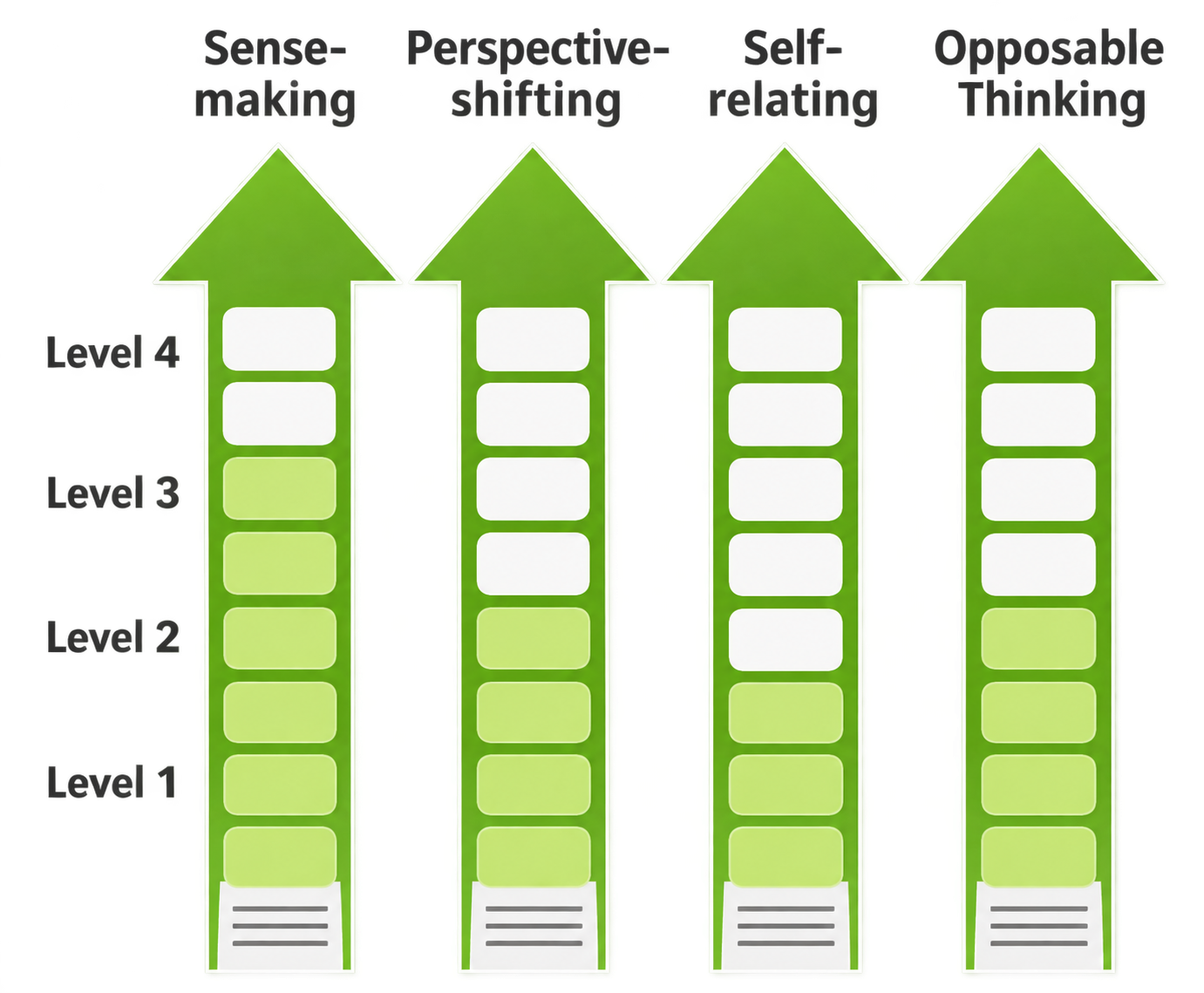
Reasoning leans most heavily on Sense-making and Opposable Thinking. Relating relies most on Perspective-shifting and Self-relating.
As the image above suggests, most people in organisations are at one of four distinct levels in each of these capacities. People who are operating primarily at Levels 1 and 2 in those capacities will usually be primarily engaged in ‘conventional’ thinking. It’s a way of reasoning that suits environments that are relatively stable, certain, simple and clear.
Those operating primarily at Levels 3 and 4 will do most of their reasoning using ‘post-conventional’ thinking. This approach to reasoning is better suited to environments that are complex, ambiguous and evolving quickly and unpredictably.
Many people are perfectly successful and happy reasoning from Levels 1 and 2. Some find it increasingly lets them down. The symptoms are pretty consistent:
Not getting the results we’re hoping for, despite a great deal of intelligence and effort
Problems that recur again and again, despite multiple attempts to fix them
A sense that the world is growing ever more ‘volatile, uncertain, complex and ambiguous’ and that we’re lacking the tools to keep up
It’s at this point that we become less and less attached to that first, conventional paradigm. In Upgrade terms, that tipping point is the transition from Level 2 into Level 3 – primarily in the capacities of Sense-making and Opposable Thinking. This shift, from conventional to post-conventional thinking, is often one of the great shifts in a person’s life. It has a profound effect on how we see everything: ourselves, the world and everyone in it.
So, what changes as we evolve?
Level 1
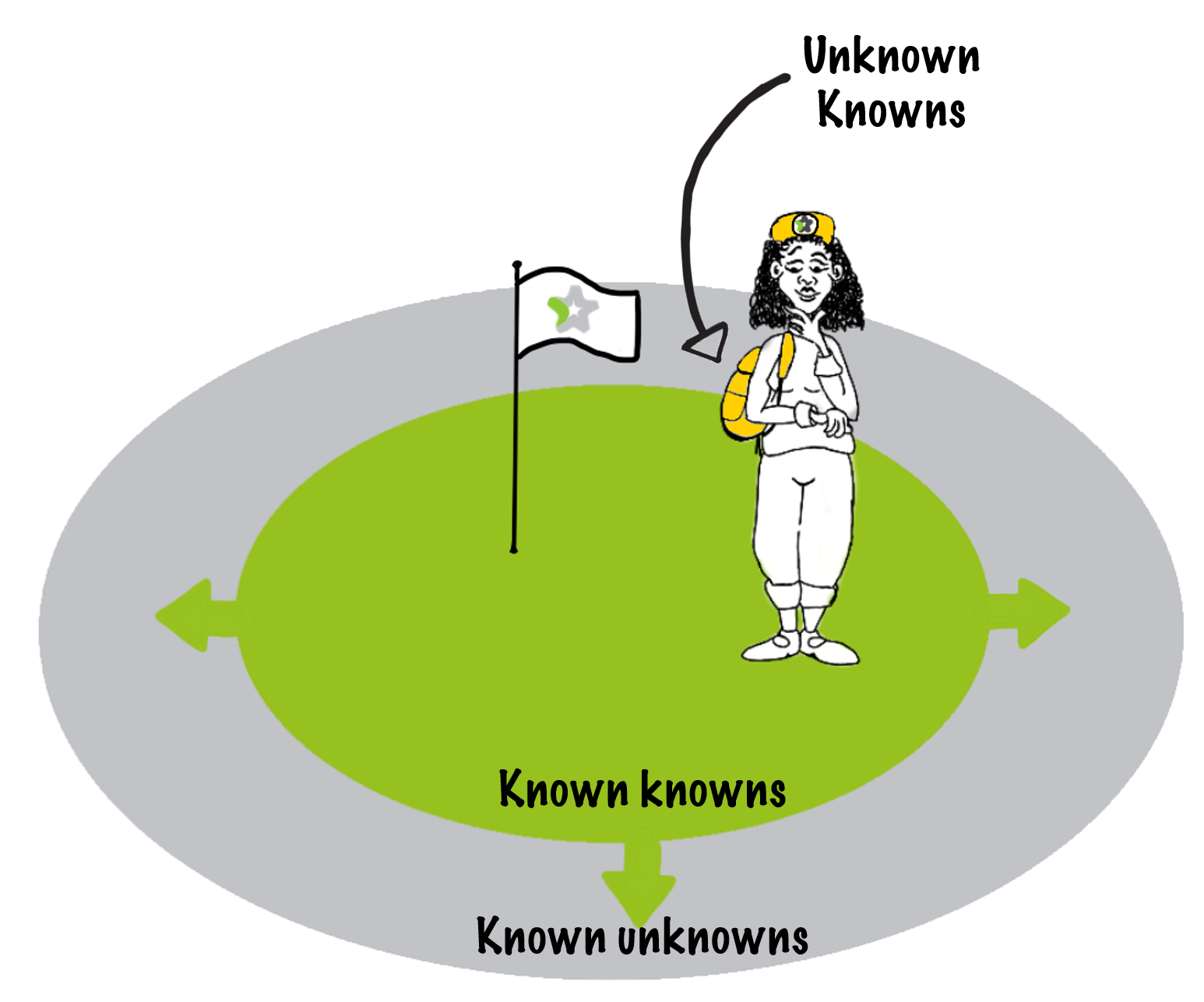
You’ve probably heard of Donald Rumsfeld’s reference to “known knowns, known unknowns and unknown unknowns”. Well, at Level 1, we focus our reasoning on:
“Known knowns” – the knowledge we believe we already have
“Known unknowns” – things we know we have yet to fully understand
In the hope of getting better at predicting and controlling what happens in the world around us, we invest in expanding the “known knowns” territory, absorbing what was once unknown. Some of us do that expansion alone; others get colleagues involved to help. Either way, when we’re doing that expansion, we usually prioritise objective data over subjective experience.
My daughter has kindly shown what I mean in the image (something to keep her occupied in the summer holidays!).
Depending on the size of your screen, you might notice that the hat the lady is wearing matches the flag marking this land of "known knowns". At Level 1, we often strongly identify with those "known knowns". We trust them deeply and we've adopted them from important people in our lives.
You might notice, too, that she's wearing a backpack. At Level 1, we’re completely unaware that we carry a whole load of “unknown knowns” everywhere we go. For example, the assumptions, linguistic conventions and social paradigms that form the foundations of our thinking. Being unaware of these means we’ve little awareness of the biases on which our “known knowns” are founded. We just treat those foundations as truths.
Level 2
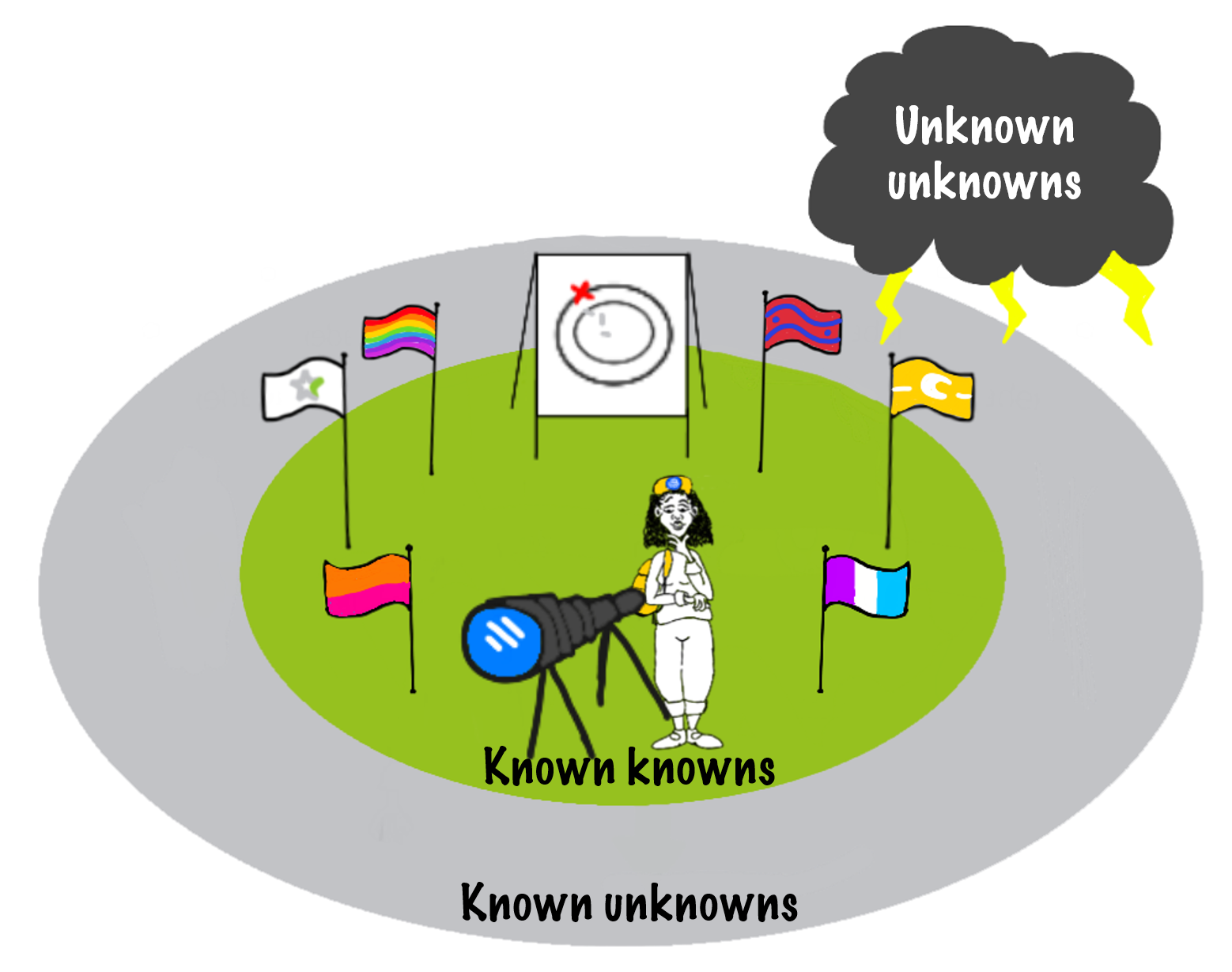
At level 2, we treat the “known knowns” as a tool to be used. We’ve appropriated quite a few of them from a few different sources, not just from within our own “tribe”. Hence the numerous flags in the image below, each representing a different influence on that territory of "known knowns". At Level 2, we recognise that each of these “known knowns” has its flaws. At the same time, we’re less interested than we were at Level 1 in how correct they are. Instead, we're focused on how useful they are.
We view the “known unknowns” differently, too. If they’re a potential threat to fulfilling our goals, then we invest in turning them into “known knowns”. If they’re not, then we write them off as a theoretical distraction. Someone else can waste time exploring that territory if they want to, but not on our time or budget.
It’s at Level 2 that we usually become more aware that there will always be “unknown unknowns”. We see that this is a potential threat to achieving what we want to in life – a storm brewing somewhere out of our field of view. We’re not yet sure how to spot the storm before it comes or how to prepare for it, but we’re usually pretty adept at responding when it arrives.
We’re also becoming more aware of our backpack of “unknown knowns”. We start to notice some of those assumptions and the impact they’re having on our thinking.
Level 3
At Level 3, we’re really beginning to question our “known knowns”. We are increasingly aware that the data and senses we’ve used to form those “known knowns” are:
Limited in scope – e.g. we can only see and hear fairly narrow spectrums of light and sound with the naked eyes and ears, and there are many wavelengths that simply escape us
Seriously flawed – e.g. our memories of what we’ve seen and heard are incorrect even seconds later; the number of known human biases listed on Wikipedia already fills six sides of A4 paper
Thus we question the possibility of being truly “objective”. We’re realising, too, that our “known knowns” are rooted in lots of assumptions and imported belief systems. Not only that, but those same belief systems are themselves based on observations made and interpreted by people who were also subject to their own confirmation biases and non-scientific agendas. So – as in the image below – we are digging deep into the foundations of the “known knowns”, to understand and challenge them.
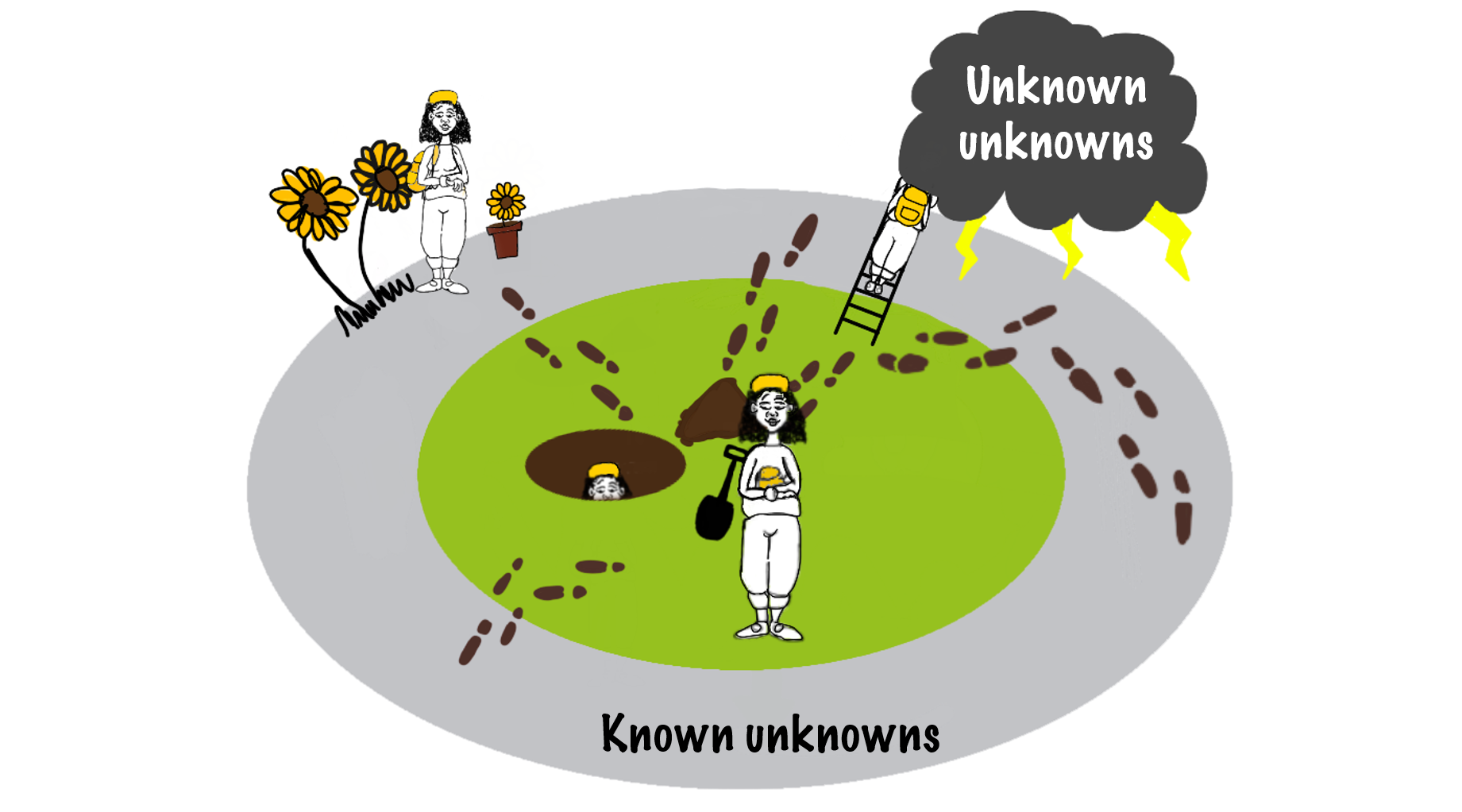
At Level 3, we’re also out exploring the further reaches of the “known unknowns”. You’ll notice the woman in the image above isn’t chopping the heads off the sunflower to use it as decoration. She’s bringing it back alive so it can continue growing in her world of “known knowns”.
Perhaps unsurprisingly, we’re also actively mining our “unknown knowns” – particularly if we’ve reached Level 3 in the Self-relating capacity. We’re opening up the backpack, asking whether the foundational assumptions and beliefs within it are really ours. We’re wondering where else they may have come from and whether they’re still as useful as we thought they were.
You’ll notice, too, that the lady in the image above has also taken an active interest in the “unknown knowns”. At Level 3, though, we can become lost in those clouds and find it hard to get others to pay attention to them. That’s partly because we’re still struggling to articulate what we’re seeing up in those clouds. So, the folk at Level 2 get frustrated with us. They already know the cloud is there, and they already know it’s potentially problematic and hard to understand. To someone at Level 1 or 2, our Level 3 attempts to navigate “unknown unknowns” can feel like they’ve just asked for tomorrow’s weather forecast, only to be given a three-hour lecture on the complexities of meteorology.
Level 4
At Level 4, we’re playing with a wide range of lenses for looking at the world. We’re seeing patterns in data that we’d never noticed before. We’re not just looking at the present, recent past and near future. We’re seeing patterns that span generations, centuries and even millennia. We’re consciously choosing these different kinds of data, based on the qualities, uses, and pros and cons of each.
In doing so, we’re dissecting multiple “known known” mental models of the world around us. Some we’ve borrowed or inherited; others we’ve created ourselves. We’re also purposefully and methodically dissecting carefully-selected “known unknowns” and mixing those in with the “known knowns” to form the basis of single, digestible meal. The meal is a narrative, consciously created, that makes enough sense of the world to take purposeful sustainable action. The narrative is deep enough, layered enough and sophisticated enough to incorporate the complexity and ambiguity of the situation. It’s adaptable enough to evolve as we go. And it’s simple enough that it works just as well for people at all levels in the organisation. It also appeals to people operating at all four levels when it comes to complex reasoning. Prior to Level 4, we often find that people at other levels don't seem to get where we're coming from.
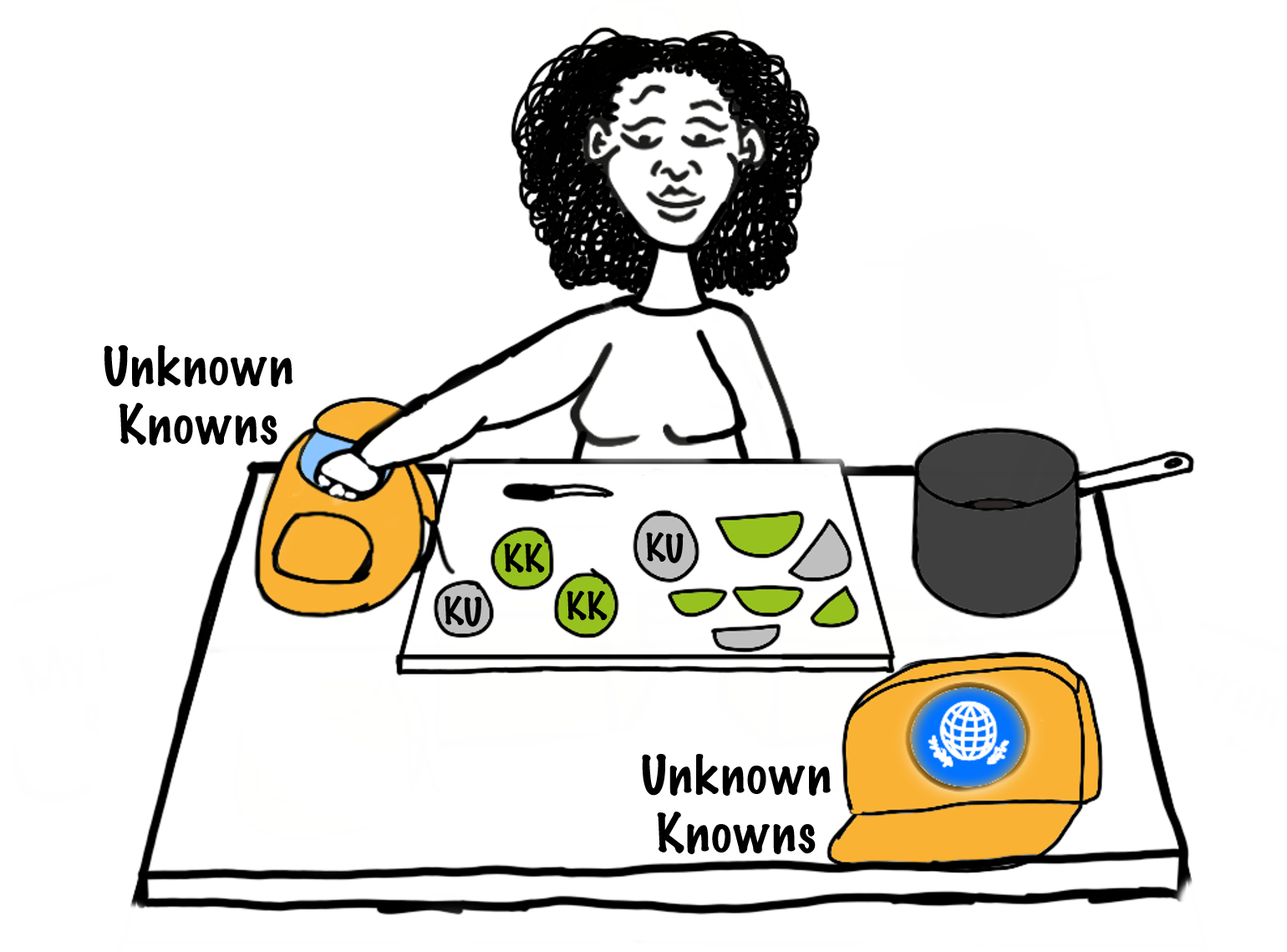
Our “unknown knowns” are also a part of this process of producing the meal. The backpack is right there on the table in front of us and we're using what's inside it. We appreciate that, however we look at a situation, it’s always from within our current paradigm. We recognise that this is inescapable, but we make those filters and assumptions as explicit as we can, always factoring them in when creating the meal. And we've spotted some new "unknown knowns", too: the hat we've been wearing all this time symbolises the ways in which our entire identity shapes the way we look at the world.
You’ll notice that the lady in the picture is using a knife at this point, not a blender. That’s because, when we first reach Level 4, managing all of these things still takes a significant amount of effort. Not only that, but the various ingredients will still be recognisable when the meal is served. People might even be able to remove them entirely, like my daughter fishing red peppers out of her risotto.
Eventually, as we settle into Level 4 in all four of the capacities in Upgrade, we might buy, borrow or make ourselves that metaphorical “blender”. When we do, we’ll find the whole complex reasoning process much quicker and it’ll require much less conscious effort. The resulting “meal” will also be more fully integrated and its individual ingredients will be harder to see. It’ll also be fluid: we’ll be less attached to its cleverness and more willing to continually update and evolve it as the world around us changes.
We’ll also become more curious about the source of the recipe. Previously, we may have assumed it was written by us or the team around us that. Now, we’ll wonder how many generations have shaped and edited it before us. We’ll wonder “Why did they make those particular decisions to shape and edit?” “What secret ingredients were added and lost on the way? How might the seemingly stable ingredients have changed over the decades, just as animals, fruits and vegetables are selectively bred to match and influence the evolving tastes of generations of consumers?”
And what of the “unknown unknowns” at Level 4? Firstly, we no longer see them as negatively as we often do when we're operating at Level 2. It’s not a storm; it’s a bunch of things that are out there and could be of use to us. At Level 4, we tend to approach these “unknown unknowns” using the techniques we learned for getting at the “known unknowns” and “unknown knowns”. We’re using observation and analogies. Darwin used both when he first explored the Galapagos Islands and emerged with the theory of evolution. Sales Directors do it when they first apply the analogy of farming to the selling their products and services.
We can sometimes do this “abductive thinking” at Level 2 and 3. However, at Level 2, we generally need to be convinced to do it, using an analogy someone else has suggested. At Level 3, we tend to buy into the idea more easily, but we’re less likely to do it spontaneously, using an original analogy, than we are at Level 4. We’re also less able to guide others through the process.
When we don’t (or can't) access this “abductive” way of reasoning, we run the risk of applying old models to new problems. Hence some people's tendency in 2020 to lean too heavily on what happened a hundred years ago with Spanish Flu when trying to predict what would happen with covid-19. There’s a chance of being right, but the context is different in so many ways that we’re more likely to be right through luck than judgement.
Sliding backwards
One hugely important thing to bear in mind is that "reaching" a certain level doesn't mean we approach every problem with that degree of sophistication. We'll still sometimes slide backwards into a more simplistic way of thinking. Maybe it's because we're tired, hungry, frustrated, rushing or stressed. Maybe the situation presses emotional buttons that trick us into taking a less "mature" approach. Maybe our reasoning brushes up against our values, so we take things more personally and find it harder to consider alternative perspectives.
Whatever the cause, it's important to recognise that we don't always reason as effectively as we can. Similarly, when other people's thinking seems "faulty", it could be that they too have been temporarily hooked and dragged back into levels of reasoning that they thought they'd left behind. The challenge for all of us is that the more complex, ambiguous and fast-paced our environments become, the more likely we are to be hooked.
In conclusion
Most of the challenges we face these days involve significant amounts of complexity, uncertainty and ambiguity. They also tend to evolve pretty quickly. If we’re going to respond effectively, our reasoning skills need to be pretty sophisticated. Developing the four capacities in Upgrade helps enormously. Reasoning leans most heavily on the Sense-making and Opposable Thinking capacities, but also draws on Perspective-shifting and Self-elating.
As we’ve seen, when we’re operating at Levels 1 and 2 across the capacities, we tend to engage in “conventional thinking”, applying our “known knowns” and reducing or controlling the “known unknowns”. As we move to Levels 3 and 4, we move into “post-conventional thinking”. This enables us to process far greater levels of complexity and ambiguity, cope better with uncertainty and adapt more effectively as the world around us continues to evolve. We just need to watch out for the hooks that can drag us backwards into less sophisticated ways of thinking.
If you’d like to know more about the four capacities underpinning complex reasoning, you can buy, or see free chapters, of Upgrade. The book is filled with case studies showing how each of these capacities and levels plays out in practice. It offers further insight into the hooks that can drag us backwards. Most importantly, it's filled with tools to help you 'upgrade' from one level to the next.
With thanks to my co-author Karen Ellis for comments on the first draft, and to Evie Boston for the artwork (pretty productive for the last day of the summer holidays!).