Are we really making any significant progress on resilience?
The other day, a client was complaining that – despite numerous revisions – their resilience training really wasn’t hitting the spot. The underlying theory seemed sound enough, but the course wasn’t ‘sticky’ enough to make much sustained difference to the behaviour and well-being of its target audience.
There are two obvious reasons why this might be the case:
The course in question is a one-off with no real follow-up – when we already know that changing people’s habits takes weeks and weeks of sustained effort
The style or content of the course might be a contributing factor – I’ve not seen it, so I couldn’t say
A little less obvious, perhaps, is the fact that most organisations running resilience programmes invest far more sustained time and effort reinforcing the kinds of behaviours typically associated with the opposite of resilience. Too many successful, driven organisations have macho cultures where ‘being able to take it’ is expected – as is being ‘always on’. All too often, working through the night has been a rite of passage for generations of senior figures. Dinner and drinks with colleagues or clients grease the wheels of business, while clogging the arteries of everyone involved. Being in poor shape physically – at least if you’re a man – seems to confer greater gravitas than taking regular exercise. Sitting is the default position. The sensation of sunlight on one’s skin is solely for weekends and holidays. Individualism is king; asking for help and expressing anxiety are the career-limiting paupers.
A one-off resilience workshop has little chance of tipping the scales in the opposite direction. If anything, it runs the risk of making the organisation seem hypocritical.
“I’ve heard such interventions referred to as the equivalent of an abusive spouse buying their other half arnica pills to help reduce the swelling.”
If the organisation cared enough about its people, the argument goes, then it would treat them in ways that meant resilience training simply wasn’t necessary.
These are factors, for sure, but they’re an oversimplification. The reality is, the world is more fast-paced, unpredictable, complex and confusing than it was in the 20th Century. That’s not to say the last century was an easy one. It was tough for an awful lot of people. We had catastrophic wars, the emergence of new, competing ideologies that brought whole clusters of nations into conflict. We had an explosion of new technologies that included the creation of the atomic bomb – still the most devastatingly horrific technological step-change the world has ever seen.
But, at the same time, the day-to-day world of the average person was relatively simple. We had fewer choices, in all aspects of our lives. Our communities and stakeholders were less diverse, more like us. The events that affected us were more localised, as were the effects of the decisions we made on a daily basis.
I’d argue that in the face of this kind of challenge, individuals, teams and organisations need to properly step up. We need to evolve, not tack on a string of ‘band-aid’ style tips, tricks and life hacks. Most resilience training basically ‘adds more apps’ to us as individual human beings. It doesn’t upgrade our underlying operating system. Not only that, but it treats each of us in isolation, rather than working at the team or organisational level to create mutually sustaining systems of interconnected individuals.
What does it mean to evolve? To upgrade that operating system, rather than adding more apps?
It means accessing the world of ‘vertical’ or ‘adult constructivist’ development. It’s a world that’s been growing and deepening for decades but is only just approaching the mainstream. It’s a world that offers clarity on what it means to progress from one level of operating to the next – the same kind of clarity we’ve had for years when it comes to children’s development.
It’s also a world that can be hard for the average person to navigate – a world of intricate theories and scarce practical application. Hence the decision to write a new book, Upgrade, with Karen Ellis. Karen has deep, deep expertise in this field of vertical development and it’s been a pleasure to work with her to bring such rich wisdom to a wider audience.
We argue for four capacities that are critical to building individual and collective resilience.
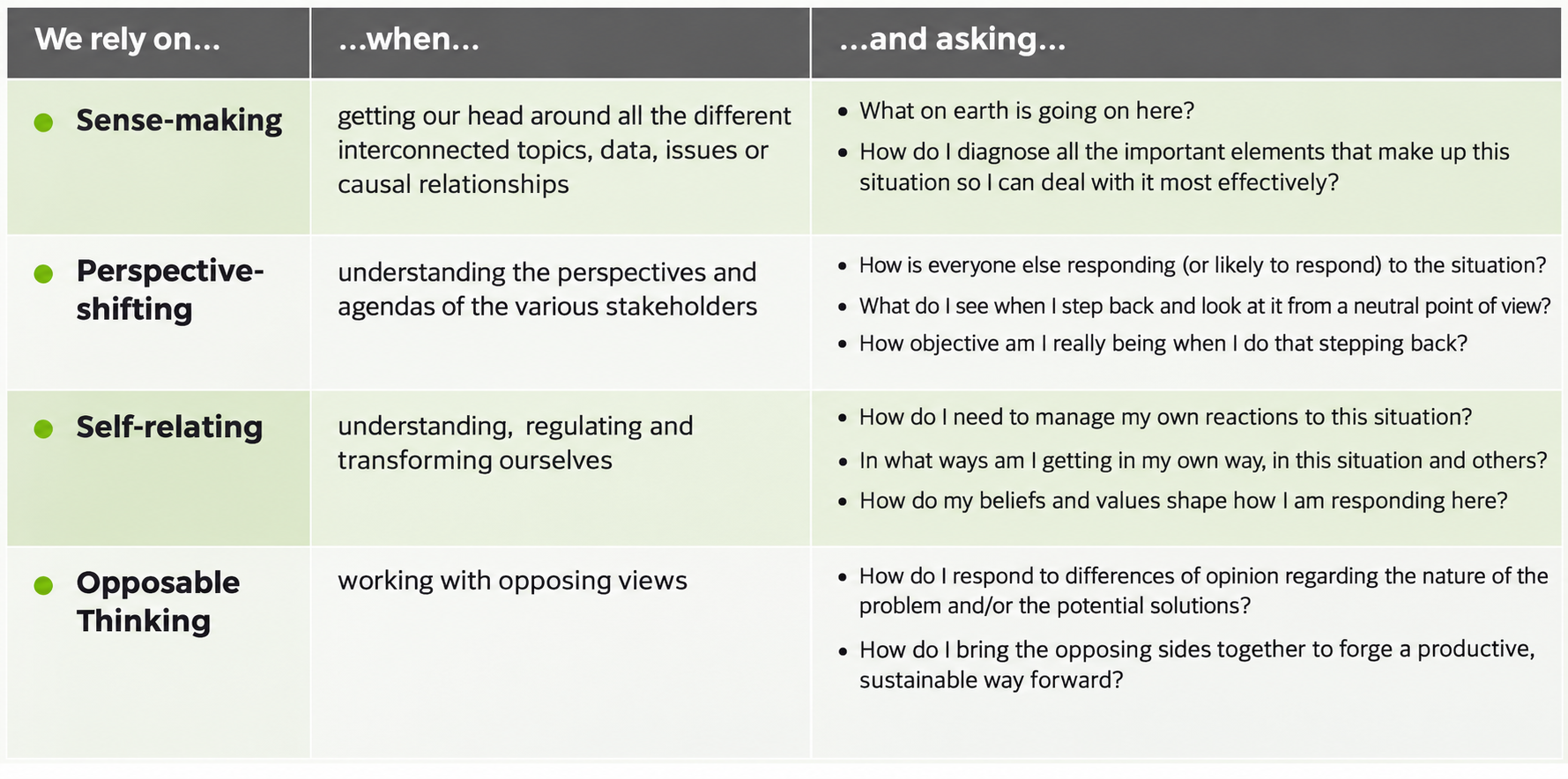
It’s pretty easy to see how we rely on each of these capacities to respond ‘resiliently’ in the face of complexity, conflict and challenging workloads. For example:
Sense-making helps us simplify the messiness, without over-simplifying it
Perspective-shifting helps us see the situation from multiple points of view and notice the skews in our own attempts to be objective
Self-relating gives us an ever-more sophisticated take on our own habits, needs and mind-sets, and the ways in which those might be helping or hindering us
Opposable Thinking helps us navigate the polarising tensions within and around us
Every one of us operates at a certain ‘level’ in each of these capacities – and not necessarily the same level in all four. In Upgrade, we focus on four levels, the first two of which are the levels at which most people operate in organisations. Each level leaves us better placed to cope with the messiness of life in the 21st Century.
Developing ‘vertically’ means consciously and intentionally progressing through these levels. Thus, we’ve included a host of practices to help the reader upgrade from one level to the next. We’ve also shown how these capacities and the four level play out in the way groups and teams operate, so you can identify the necessary collective upgrades, too.
I covered resilience in my first book, ARC Leadership, which offers the ‘resilience bomb’ as a way of looking at our individual responses to challenging situations, then offers various tactics and strategies to help individuals build resilience. My second book, The Boss Factor, seeks to reduce the need for resilience in the relationship between leaders and the people they lead. Upgrade transforms the way people relate to themselves, other people and the world around them. So it’s more likely to help create the “mutually sustaining systems of interconnected individuals” I called for earlier in this article.
There’s no panacea, but if you build the four capacities at the heart of the book you’ll inevitably create a step-change in your own resilience and that of others.
Want to know more?
You can buy the book Upgrade, or sample some free chapters, in our BOOKS page.
Here's what people are saying about it...
“A really important book... timely and vital... does what previous authors in this field have tried and failed to do… profound depth and immediate application.” Peter Young, Bladon Leadership
“A great entry point for even the most cynical of people... just the right level of intellectual and personal challenge... ” Caroline Britton, Revolut
“Fresh... engaging... practical... infectious... concepts you’ll recognise... and want to share...” Michael Borthwick, Claranet
“You’ll feel compelled to use it... a reference you’ll keep coming back to.” Danielle Lewis, Southampton Football Club